Before smartphones and streaming services, Zambia's greatest stories travelled from grandmother to grandchild, whispered around crackling fires under star-filled skies. These weren't just bedtime tales—they were blueprints for understanding death, nature, and the invisible world. From a man's perilous journey to reclaim his wife from the underworld to the masked ancestors who still dance among the living, Zambia's folklore pulses with magic, morality, and timeless wisdom.
Zambia’s oral history is rich in folklore, brimming with magic, wisdom, and insight into the origins of tribal beliefs. These stories have been passed down through generations from lap to ear. From Chiluba’s perilous journey to the land of the dead to the Chewa myth unveiling the origins of the nyau masks, each tale offers a window into worlds seen and unseen. What serves as bedtime and campfire stories also reveals imagination, morality, and cultural memory. These stories continue to shape us.
Chiluba's Journey to the Land of The Dead
At a time when the Earth was new, there lived a man named Chiluba. Chiluba loved many things, but he loved his wife the most. They lived a happy life together, full of warmth and the sound of laughter. One day, his wife fell ill. Despite every herb they applied to her body and every tincture they poured down her throat, she became worse. She was soon claimed by death.
Chiluba was torn apart with the grief of never seeing her again. In his determination to be reunited with her, he resolved to do what no man had done before - set off on a journey to the underworld. He journeyed through the harshest rivers, travelled through the strongest winds and felt the burn of the harshest flames, compelled by nothing but his love for the woman he loved and the scent of her favourite flowers guiding him to her.
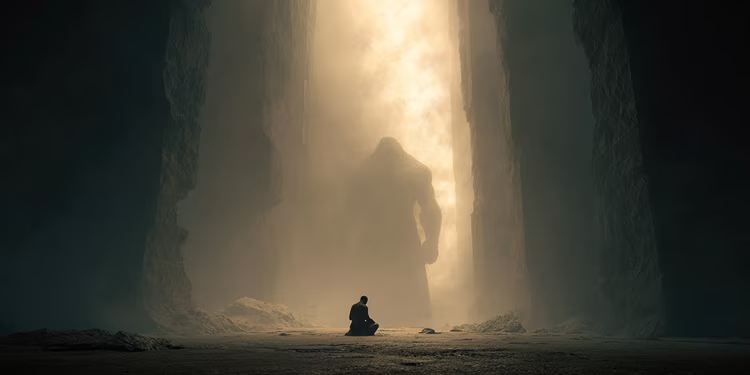
He was met by a grand spirit that ruled over the land of the dead, and the spirit was so moved by Chiluba’s dedication that it allowed him to see his wife only for a short time. She appeared as beautiful as he remembered, but she was changed, more spirit than person. Her parting gift to him was a stone and sacred knowledge about the sanctity of death, funerals and the important burial rites that forever bind the living and the dead.
And Chiluba returned to the land of the living with stone, the knowledge given to him which he imparted to all he knew, and his heart still bursting with love for the wife he had lost until the day he saw her again.
How Death Entered the World: The Lozi Story of Nyambe and Kamunu
In the beginning, there was only Nyambe, the creator and his wife, Nasileli. Nyambe was content with the land as a vacant space. He liked the air without the sound of tree leaves rustling and forest birds chirping, but Nasileli felt the pangs of loneliness’s ache. And so to appease her, he made the still leafy creatures that grew out of the ground and those with legs that ran across it, as well as beings with fins and wings to claim the waters and the skies.
But though these pleased Nasileli, after some time, she felt that familiar ache and asked for more. Nyambe knew that the creation of mankind would only bring sadness, but seeing as the only way to cure his wife's current pain, he relented and moulded and breathed life into the first man, Kamunu.
Kamunu was the smartest of all of Nyambe’s creations and eager to learn. He kept his eyes on Nyambe and mimicked everything he did. Through that, he learned the craft of moulding clay, the science of forging metals and the practice of agriculture.
At first, Nyambe was impressed, but he soon grew tired of the watchful creation that copied everything he did. And his tiredness turned into anger when Kamunu killed an animal and roasted it for its meat.
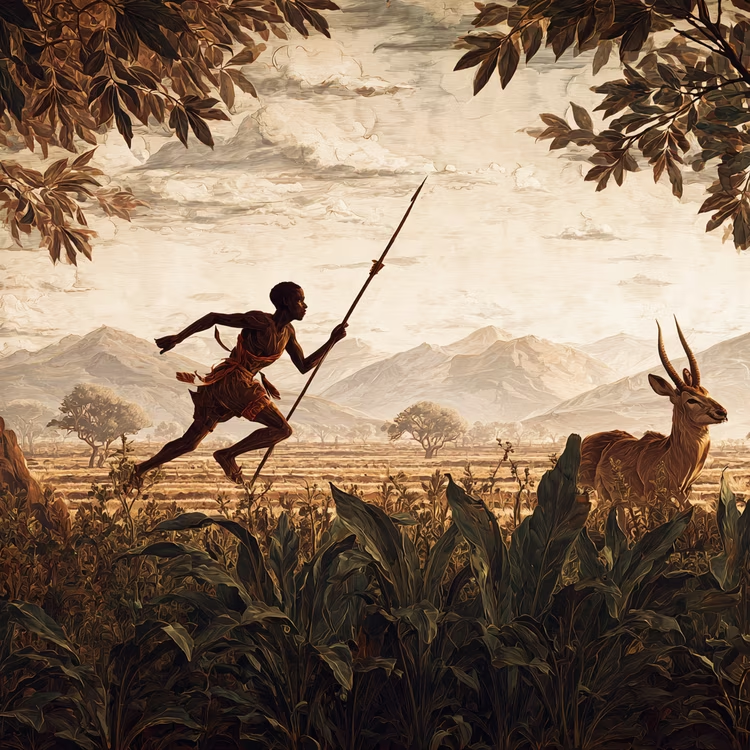
Nyambe was enraged that Kamunu had killed one of his brothers. And Kamunu left in shame but struggled to survive without the guidance of his creator. Nasileli, taking pity, convinced Nyambe to invite him back with the promise never to kill one of his brothers again, and so Kamunu came and grew crops in a beautiful garden next to his creator.
One day, an antelope came to graze in the garden and, defying Nyambe’s orders, Kamunu killed it to prevent it from destroying his crops. Again, Nasileli was enraged and began to take away Kamunu’s precious possessions each time he killed an animal to punish him. First, he seized Kamunu’s favourite pot, then, with Kamunu’s next violation, he killed the dog that he loved. And when Kamunu proceeded to kill another animal in a fit of rage and exasperation, Nyambe took away Kamunu’s son, and that is how death entered the world.
The Chewa Masked Spirits of the Gule Wamkulu Ritual
At the dawn of things, there was a separation. Above ground were the living, and below it were the ancestors who could both give and take away in the world, supremely governed by Chauta, the creator. But the living, at the dawn of things, lacked knowledge about most things, and though their ancestors existed just beneath them, they knew not the proper way to ask them.
Because of this, they experienced bundles of misfortune in crops that died before bearing fruit, diseases that reduced their populations and droughts that made them weak with hunger.
Finally, a famine came to the land, threatening to take the bulk of what the people held dearest and in desperation, they sent a group with offerings of milk, millet and charms to the land of the ancestors. Taking pity and speaking through a shaking reed, the oldest ancestor proposed a compromise - they would come and assist and give guidance to the living, but only if the living would grant them the respect of secrecy.
And so it was decided that the ancestors would show themselves dressed in costumes and masks that the living constructed and only trusted a select few with the divine knowledge of.
From then on, the Gule Wamkulu dance was born and even now, with all the passing of time and all the living that have been born and joined the world of the ancestors, since they still come to assist the living, shaking and dancing to impart their wisdom.
Beyond entertainment, these myths offer profound insight into the tribes we come from. The Bemba tale of Chiluba illuminates burial rites and the veneration of ancestors, the Chewa myth “unmasks” the mysteries of the Gule Wamkulu ritual, and the Lozi story of Nyambe and Kamunu reflects a deep reverence for nature. Delve into Zambia’s folklore, and you may discover that the next epic story to captivate your imagination isn’t on television or in a bookstore - it’s waiting at your grandmother’s feet.