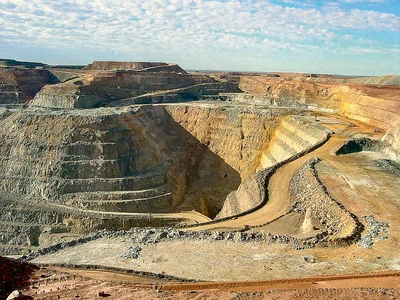
The North-South Corridor carries 50% of SADC trade. Discover how transforming this route into a smart, industrial economic zone could unlock $16.1 billion for the region, create 1.6 million jobs, and redefine Zambia’s role as a continental logistics and manufacturing hub.
For decades, a major artery has sat silently as the lifeline of an entire continental region. This conduit of commerce is estimated to carry around half of all SADC trade flows and as much as 60 per cent of regional (intra-SADC) transit trade, stretching from the mining-focused Katanga Province in the Democratic Republic of the Congo (DRC) to the seaports of South Africa; its path traverses Zambia, Botswana, and Zimbabwe. This transit route, which facilitates the flow of goods between landlocked countries and the rest of the world, is known as the North-South Corridor, or NSC for short.
The NSC is poised to become the backbone of Southern Africa’s growth: an integrated, smart economic corridor that is set to transform industry and drive sustainable progress across the SADC region.
In July 2025, a high-level validation workshop for the NSC Economic Corridor Pilot Programme was held in Johannesburg, focusing on transforming the NSC into an efficient, digitally connected ecosystem. The aim is to strategically link economic hubs, industrial parks, and smart logistics nodes, positioning the corridor for regional integration and progress.
The North-South Corridor connects seven countries: Botswana, the Democratic Republic of the Congo, Malawi, Mozambique, South Africa, Zambia, and Zimbabwe. It effectively grants access to a market with a combined population of approximately 280 million. The corridor provides access to massive mining belts, vast tracts of arable, fertile agricultural land, and hydroelectric systems driven by major waterways such as the Zambezi, Kafue, and Limpopo rivers.

Historically, the NSC has played a crucial role in facilitating the movement of minerals and agricultural exports. Zambia and the DRC rely on their roads and rail networks to access the ports of Durban and Beira. However, bureaucracy and infrastructure gaps raise costs and reduce competitiveness. Transforming the corridor would enable materials processing near sources, local value addition, and easy access to logistics data.
Upgrading the NSC is a transformative investment expected to inject up to US$16.1 billion into the region’s GDP and create 1.6 million jobs by 2035. These benefits are anticipated to uplift youth, women, and SMEs, strengthening Africa’s economic foundation.
For Zambia, the NSC’s full potential lies in transforming it from a traditional logistics route into a catalyst for industrial clusters, particularly in manufacturing, agro-processing, and green energy. This shift would boost Zambia’s industrialisation, value addition, and export diversification, bolstered by its role as a regional logistics hub.
To tackle the inherent bottlenecks of unsynchronised regulations, intermodal transport limitations, and the high cost of doing business, the new NSC will seek to implement various enhancements, including digitised logistics platforms enabling real-time cargo tracking and predictive maintenance for vehicles and rail systems, automated customs processing through one-stop border posts, economic zones placed throughout the corridor hosting manufacturing, green energy, and value-addition industries, and critically, upgraded and integrated infrastructure across road, rail, and dry ports built to be highly efficient and sustainable.
The World Bank estimates that landlocked countries pay up to 50 per cent more in trade costs than their seafaring neighbours. A smart, integrated corridor would enable land-bound producers, such as those in Zambia, Zimbabwe, and Malawi, to become more competitive on the global market by levelling the playing field.
Several member states are already moving ahead with domestic reforms to capture these gains. Zambia already has its pedal to the floor with the implementation of multi-facility economic zones (MFEZs) in the Zambian section of the corridor. Encouraging developments in the digital tracking space have seen pioneering logistics firms develop and test tracking tools on certain sections of the corridor. One potential stumbling block still exists, though—the harmonisation and synchronisation of national agendas for the greater (regional) good. All national players must align under a shared framework to make it a truly integrated economic zone.
The African Union’s Programme for Infrastructure Development in Africa (PIDA) suggests that upgrading the corridor will require several billion US dollars (over US$6.5 billion) for its initial phase alone. Other key risks revolve around gaps in intergovernmental coordination, shortfalls in infrastructure—specifically, secondary roads and rural linkages—and the possibility that countries already fiscally strained may not prioritise the NSC revamp, raising social and environmental concerns about land use and displacement along the corridor expansion route.
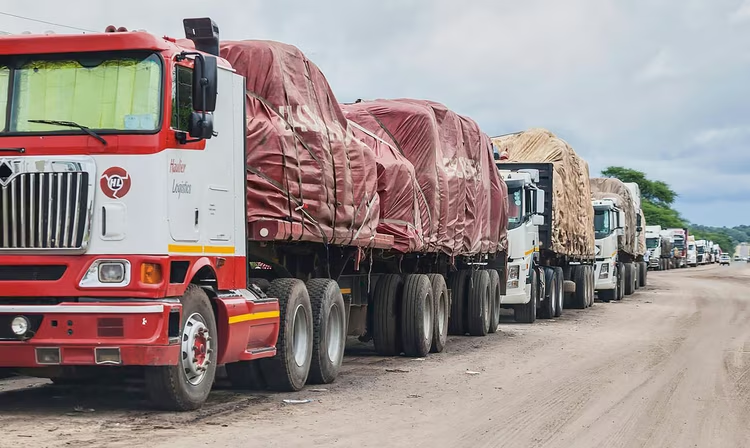
As a mitigation measure, the Johannesburg workshop proposed a Corridor Governance Framework, a central oversight coordinating body composed of representatives from participating states, development banks, and private investors, to ensure a transparent process from design to implementation and beyond, including the management of this regional asset.
With the NSC, SADC would be drawing the blueprint for a successful regional development plan that is both inclusive and mutually beneficial. The establishment of industrial parks and MFEZs along the corridor could be the lifeline that rural communities have been waiting for to revitalise their production capabilities. This action would catalyse the growth of SMEs, women-led enterprises and youth-led enterprises.
The entire project aligns with the African Continental Free Trade Area (AfCFTA) and Agenda 2063, both of which prioritise regional integration, value addition, and sustainable development at the forefront of African development. The North-South Corridor holds the key to connecting farmers to broader international markets, linking entrepreneurs to investors, and presenting communities with a vast array of opportunities.
For the SADC region, the North-South Corridor represents much more than a transport and logistics project—it symbolises possibilities. Transforming that possibility into reality will require coordination, investment, and capacity-building. Governments need to allocate funds for NSC projects, and development partners should encourage co-financing. Ultimately, Zambia’s SMEs, young entrepreneurs, and rural producers will benefit. After all, a corridor is only as strong as its people.