Making money feels good. Whether it comes from a side hustle or a salary, there’s a certain pride in seeing effort turn into income. It’s proof that your time meant something. But there is a better feeling than earning money once: watching that same money quietly produce more money. The moment it starts stretching beyond the month it was earned, beyond the bill it was intended for, and begins influencing your future instead of just surviving your present, your relationship with money changes.
What is investing?
At its simplest, investing means putting money into something today so that it grows tomorrow. You delay spending in exchange for future comfort. Instead of money lying dormant in an account, it becomes a worker. A small worker at first, but one who can allow you to retire comfortably.

Many Zambians already invest without labelling it as such. Buying a plot in Chongwe for a future investment property. Keeping goats in the village for resale later. Contributing to a chilimba that rotates into a business purchase. The formal financial world only adds structure and regulation to a behaviour we already understand culturally.
Is Investing Accessible in Zambia Today?
More than before, less than it should be.
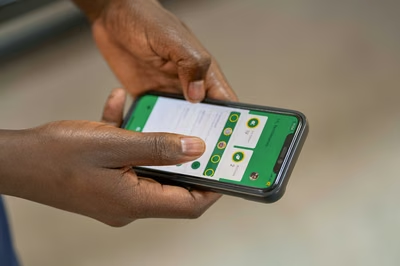
Ten years ago, investing required knowing someone in a bank or earning enough to be invited into a meeting room with air conditioning and brochures. Today, the phone in your hand can open a unit trust account. The barrier has shifted from access to understanding.
Financial educators like Finances with Chipepo and Chanozya Kabanghe constantly emphasise that many people do not avoid investing because they lack money, but because financial language feels foreign. The moment terms sound complicated, people assume the door is closed. In reality, most entry points require less money than a new pair of sneakers.
Beginner Investment Options in Zambia
Unit Trusts
Think of a unit trust as a large basket managed by professionals. Many people contribute small amounts; the fund invests collectively in bonds, shares, and treasury securities; then profits or losses are shared proportionally.
Minimum: Often K100 to K500, depending on the fund.
Risk: Moderate.
Expected Annual Return: Roughly 10% to 18% over time (varies by market conditions).
Example: If you invest K200 monthly into a fund averaging 12% annual growth, after five years, you are not sitting on K12,000 in savings - you are sitting on significantly more, thanks to compound interest. Time does the heavy lifting.
This is usually the safest starting point because it spreads risk across many investments instead of betting on one.
Angel Investing in Zambia
This is the opposite personality. Instead of lending money to governments and companies, you invest directly in startups. Zambia now has small investor communities where individuals pool funds to support early businesses.
Minimum: Often K5,000 and upward.
Risk: High.
Return: Either very large or zero.
Angel investing is not for emergency money. It is patient capital. A business may take years before profit appears, and many never do. But the few that succeed can multiply your investment several times.
Example: Invest K5,000 into five small startups instead of one. If four fail and one succeeds fivefold, you still grow your money.
Micro-Investing Apps Like Patumba
These are probably the most culturally important developments in Zambia’s investment space. Apps like Patumba allow users to invest small amounts regularly into structured funds without needing large bank balances.
Minimum: as low as K10 or K50.
Risk: Low to moderate, depending on the fund.
Return: similar to conservative funds, often around 8% to 14% annually.
You do not need to feel rich before you start. A student setting aside K20 after each airtime purchase builds an investing habit before they build a salary.
Why Investing Feels Slow
Why does a betting group attract more people than a financial literacy workshop? Because betting promises a money facade, and investing demands patience.
Human beings prefer visible outcomes. A football ticket gives instant emotional feedback: hope tonight, disappointment tonight. Investing is quiet. Nothing exciting happens for months. Sometimes years. The brain interprets silence as failure even when growth is happening underneath.
Another factor is familiarity. Risk that feels entertaining is accepted. Risk that feels academic is avoided. Yet mathematically, things like betting guarantee loss over time, while diversified investing statistically rewards patience.
Chipepo often frames it in simple terms: if wealth required excitement, every gambler would retire early. Wealth usually looks boring while it is forming.
How to Start Investing With Little Money in Zambia
You do not begin with a grand portfolio, just discipline and a rule. Choose an amount small enough to repeat every month without thinking. K100 is fine. Consistency matters more than size. Then choose one simple vehicle first. Usually, a unit trust or micro-investing platform. Watch it for six months. Understand how statements work. Let your confidence grow with your balance. After that, you can experiment with higher-risk options like startups or equity funds.
Investing in Zambia is no longer a privilege reserved for high earners. It is now a behavioural choice. The tools exist, the minimums are accessible, and the information circulates widely, even in WhatsApp voice notes between friends trying to decode financial independence together. Moving from asking “What can I buy this month?” to asking “What can grow this month?” The difference between those two questions is usually the difference between income and wealth.