For Mubanga Kalimamukwento, writing is not a performance but a quiet act of preservation. Her sentences gather the voices of women, the weight of silences, and the rhythm of everyday speech. From her Lusaka childhood to the pages she now fills, Mubanga’s fiction listens closely—to loss, to laughter, and to the language of those often left untold.
Mubanga's journey into writing began, in a way, with loss, when she lost both her parents by the age of 11. In the aftermath, Mubanga often found herself poring over the obituaries in The Daily Mail and The Times of Zambia. She pondered the lives of the people on the pages and crafted stories about them. Mubanga didn't realise it then, but these were the beginnings of her journey to becoming a writer.
"I realised that stories don't have a specific container," she reflects. "They exist everywhere, waiting to be collected, shaped, and shared." It was through these fragments, lives outlined in brief, sometimes anonymous lines, that she first understood how narrative could serve as a way to remember, to grieve, and to make sense of the world.
From a young age, language played a role in shaping how she would come to tell stories. Growing up in a multilingual household, Mubanga moved seamlessly between English, Bemba, Nyanja, and Tonga. Her mother, a lover of languages who taught English, English Literature, and French, instilled in her a love of words, while her father insisted that his children preserve their mother tongues. Her own children now speak multiple languages, a generational trait that is echoed in her work. "When my characters speak, I try to think about what would be their most organic way of speaking," she says, “and I think about my then three-year-old mixing English, Nyanja, and Bemba, saying something like, ‘Mummy, please, nifuna amenshi.’”
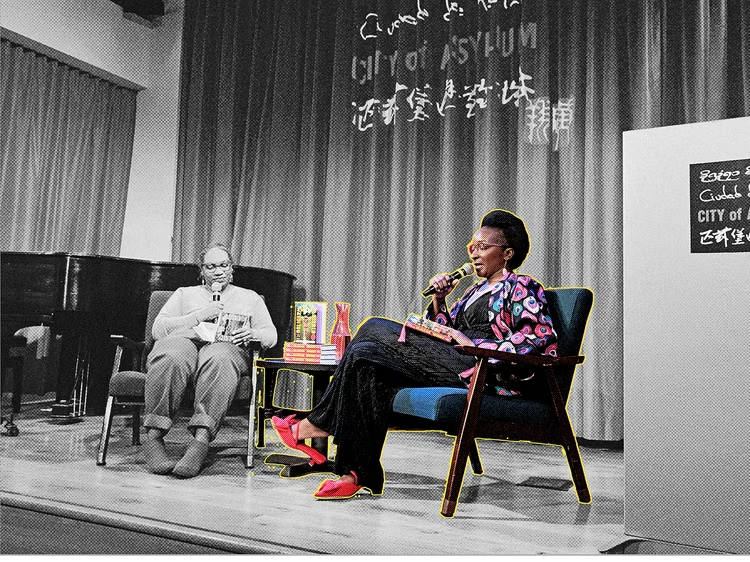
These early experiences, contrasted with an educational system that prohibited vernacular in school settings, suggested to a young Mubanga that certain languages only belonged in particular contexts. Her encounters with literature further widened this gap, revealing the limits of access and relatability. While she devoured novels at home, few were by Zambian authors. In primary school, storytelling in mother tongues was confined to small time slots, and secondary school English Literature classes included African writers, but never Zambian writers. "I had to intentionally seek out more African literature, particularly Zambian works, which were often difficult and frustrating to find," she reflects. These gaps would later influence her mission: to centre Zambian voices, particularly those of women and girls, and to expand what readers think of as African literature.
Her mother, surrounded by books, read aloud to her daily, fostering a love for both print and audio narratives. She recalls her eighth-grade teacher, Ms Muwowo, who allowed her to transform personal grief into fiction. When Ms Muwowo instructed her class to write about their holiday, it was a grim prospect for Mubanga because her father had just passed away. Recognising Mubanga's grief, Ms Muwowo instead encouraged her to write a story of her own choosing. This moment changed how Mubanga perceived storytelling and who could tell those stories.
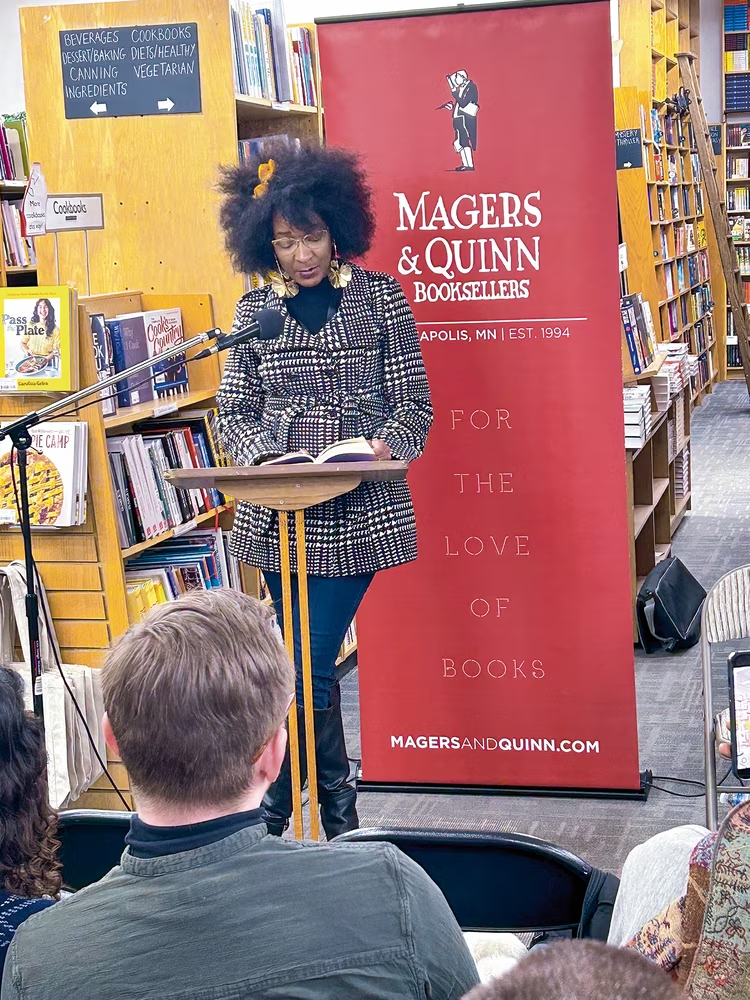
One way she is doing this is through Ubwali, a literary magazine and non-profit organisation she founded alongside co-editors Mbozi Haimbe and Fiske Nyirongo. Beyond her own writing, Mubanga is committed to nurturing the next generation of Zambian writers. Through Ubwali, she supports mentorship, prizes, and masterclasses, connecting emerging authors to international audiences. "Community building ensures none of them fall through the cracks," she says, emphasising that literary culture thrives when knowledge and opportunity are shared.
Now based in the United States, Mubanga gives back to her local community by participating in the Minnesota Prison Writing Project, which helps incarcerated individuals process their experiences through writing, offering a rare form of expression. "It's humbling," she says, "but rewarding. If we say incarceration should be rehabilitative, then providing tools for self-reflection and creative expression is essential."
The criminal justice system is close to Mubanga's heart, as she is a qualified lawyer with an LLB from Cavendish University in Zambia and an LLM from the University of Minnesota. Her personal experiences during her time at the Kabwe High Court partly inspired her first novel, The Mourning Bird.
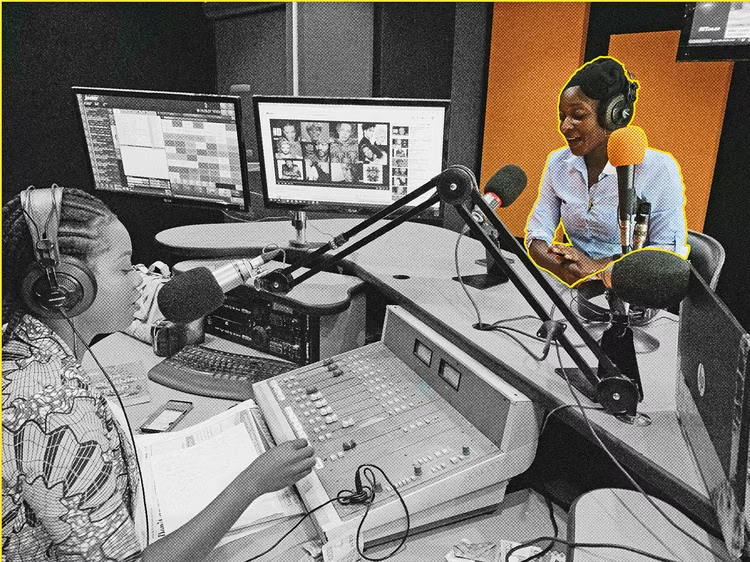
The book explores the breakdown and loss of family networks. It originated from a draft written years earlier, inspired by childhood memories and later reshaped through adult observation. A lunchtime conversation in Kabwe about children begging in the streets rekindled questions she had carried since childhood: the complex factors of AIDS, stigma, and poverty that shape lives and families. The person she was speaking to lamented the presence of the street kids at the restaurant she frequented at lunchtime, but never questioned the circumstances that led them there or why they were forced to take to the streets. Writing became a way to confront these realities and work through personal and collective grief. "Writing helped me face memories I hadn't contended with in a while, and that was healing in a way, cathartic almost," she shared.
In her short story collection, Obligations to the Wounded, Mubanga blends folklore, proverbs, and modern life. Proverbs, she explains, were central to her childhood storytelling spaces, and foregrounding them in her work enables her to firmly root her narratives in Zambian language, culture, and knowledge systems. Another reason Mubanga values proverbs is that they are typically short, yet convey a great deal of meaning, and the meaning can differ from speaker to listener. Even context can create a layer of added meaning.
Mubanga's approach to writing is rigorous and iterative. She allows ideas to wander freely in early drafts, then returns to painstaking editing, printing, annotating, retyping, and recording herself to hear the rhythm of the work aloud. She repeats this cycle until she reaches her own ceiling, then invites beta readers to offer feedback. Some works take weeks, while others take years.
For Mubanga, fiction is more than mere entertainment; it is a form of cultural dialogue. Unlike history or policy, fiction allows participation from both writers and readers, offering perspectives that might otherwise be excluded. It is political, too. "The fact that I am telling stories when my education trained me not to value them is a rebellion against what is valued and what isn't," she says.
Storytelling provides the freedom to explore people's motives and motivations fully. Looking back, despite the rigidity of legal language, Mubanga sees litigation as a form of storytelling with its own language. She believes this is part of what made her transition from lawyer to writer possible.
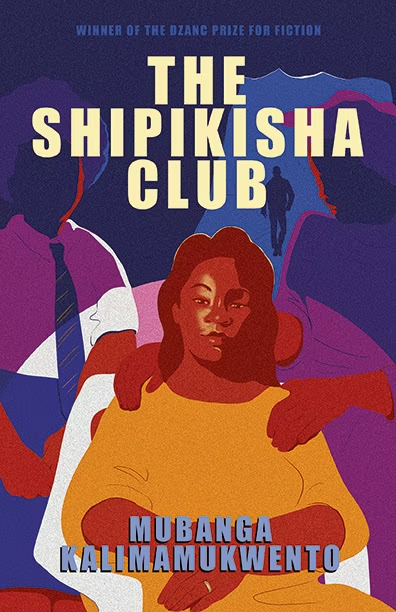
Her forthcoming novel, The Shipikisha Club, is the culmination of six years of work and promises to expand Zambian storytelling on the global stage. But for Mubanga, legacy is intimate and personal, leaving stories and gifts for her children, ensuring her presence endures in their lives: "Once my stories are published, they are no longer just mine," she says. "I can only hope the person it lands on holds it with care. My only work, my only job, is to make the story exist. After that, the readers choose what to do with it. They choose how to interpret it."
Mubanga Kalimamukwento's work has received significant acclaim. The Mourning Bird won the 2019 Dinaane Debut Fiction Award, making her the first Zambian recipient of this award. In 2024, she became the first African writer to win the Drue Heinz Literature Prize for Obligations to the Wounded, which was also named one of The Boston Globe's 75 Best Books of 2024 and was longlisted for the 2025 Carol Shields Prize for Fiction. Her forthcoming novel, The Shipikisha Club, won the 2024 Dzanc Books Prize for Fiction and is scheduled for publication in 2026.
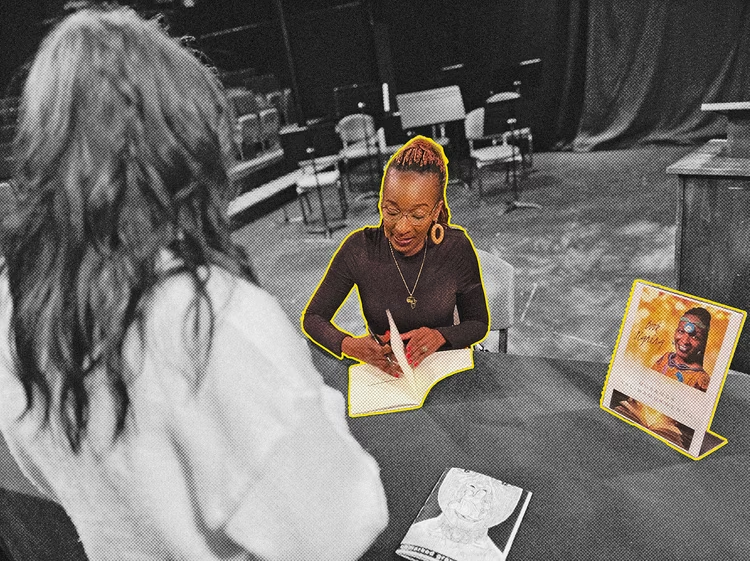
Mubanga Kalimamukwento's work is a testament to the power of narrative: to preserve memory, to give voice to the underrepresented, and to connect generations. In tracing lives from obituaries, listening to the rhythms of multiple languages, and centring the experiences of women and girls in Zambia, she demonstrates how storytelling can be both a personal act of remembrance and a cultural act of reclamation.