Global copper demand is set to surge to 40.9 million tonnes by 2040, and Zambia's mining sector is preparing for something big.
Engineers, designers, and assembly-line workers arrive at a car manufacturing plant in Shanghai as work begins. They move to their stations across the factory floor. Nearby, engineers check measurements on a circuit board connected to a motherboard before production continues.
At the centre of that circuit board is copper. Thin wires carry power through the system. Copper may be easy to overlook, but it plays a similar role in a wide range of modern items. It sits inside renewable energy projects, power transmission systems, and everyday technology, including the device you are reading this article on. As demand for these systems grows, so does the demand for copper, creating additional supply chain pressure points.
The Democratic Republic of Congo is currently Africa’s largest copper producer, supplying around 2.8 million metric tonnes a year. Zambia follows. In 2024, Zambia announced plans to increase copper production to 3 million metric tonnes by 2031, reflecting the growing importance of copper in global energy and industrial supply chains.
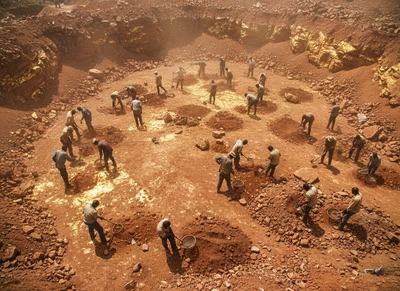
As global demand for copper is expected to rise sharply over the next two decades, reaching 40.9 million metric tonnes by 2040, Zambia currently produces around 3.5–4 per cent of global copper supply. While that share may appear modest, its significance lies in the country’s capacity to grow output over time. The mining nation is advantaged by high-quality copper deposits with room to scale; mature mining operations, some, like First Quantum Minerals’ (FQM) Kansanshi Mine, dating back decades; as well as renewed investment momentum demonstrated by International Resources Holdings’ $1.1 billion investment in Mopani Copper Mines and KoBold Metals’ Mingomba discovery. Taken together, these factors place Zambia in a stronger position at a time when buyers are paying closer attention not only to volumes, but to reliability and long-term supply security.

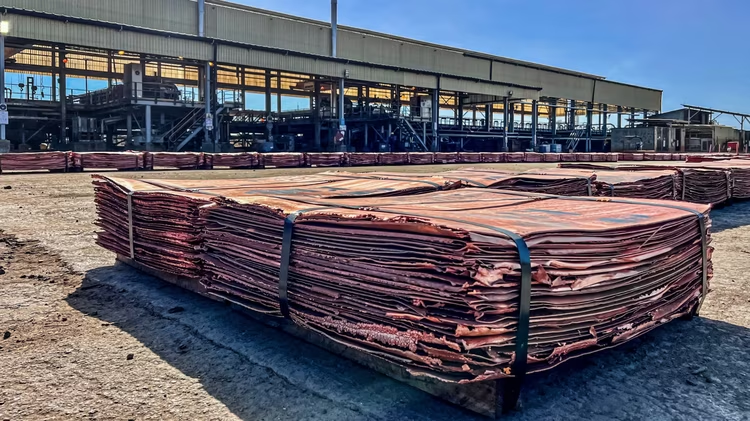
After extraction, copper in Zambia is processed and smelted into large copper plates near the mine sites before being transported by road to regional ports, including Dar es Salaam, Durban, Walvis Bay, Beira, and Lobito. From there, shipments move by sea to centres in markets such as China, Switzerland, and Singapore. In these centres, Zambian copper is refined and used in power transmission networks, renewable energy installations, electric vehicle systems, and industrial manufacturing. Its value lies in physical properties that are difficult to replicate at scale, including high conductivity, durability, and consistency.
In supply chains like these, reliability matters as much as output. Some operators are built to manage long timelines and volatile conditions; others are not. First Quantum Minerals has operated in Zambia for close to three decades, working through multiple commodity cycles while maintaining production discipline. As Zambia looks to increase output, First Quantum Minerals’ focus has remained on operational continuity, phased expansion, and long-term planning aligned with national development priorities.
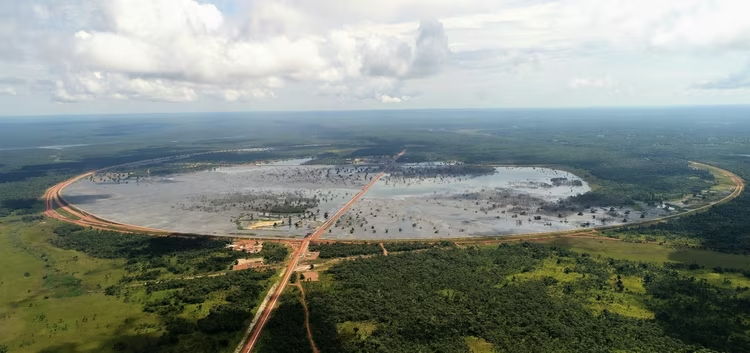
These include the $1.25 billion Kansanshi S3 expansion, which will nearly double Kansanshi’s ore processing capacity and production and extend the mine’s lifespan by at least 20 years, while securing approximately 7,000 local jobs. Power supply has become part of the practical considerations around the expansion. First Quantum Minerals has been diversifying how its operations are powered, combining electricity imports with renewable energy arrangements, including the purchase of power from a planned 400MW wind and solar project developed by TotalEnergies with local partners. In parallel, the planned expansion of the Maamba Coal Generation Plant is expected to add a further 300MW to the national grid.
At the operational level, much of this work is carried out by engineers and mineworkers whose expertise translates global demand into day-to-day output. Home-grown talent such as Jestone Mutale, whose commissioning experience at Trident has supported the development of systems from the ground up, has helped turn greenfield projects into productive operations. At the Kansanshi S3 expansion, Patricia Mankubwa, a metallurgical engineer, played a leading role in guiding the design of a 25 Mtpa sulphide circuit, work that will shape Zambia’s copper output for years to come.