I will always be inspired by Zambia’s assertiveness for innovation and development. You see it in the infrastructure rising across towns, the addition of new ministries, and the gradual strengthening of the health system. There is a clear intention to make Zambia shine on both a global and local stage. So the introduction of a new curriculum does not really come as a surprise.
Before delving into the new curriculum, it is helpful to pause and reflect on what came before it. For years, Zambia operated under acurriculum introduced in the early 2000s that emphasised a fairly uniform academic pathway.
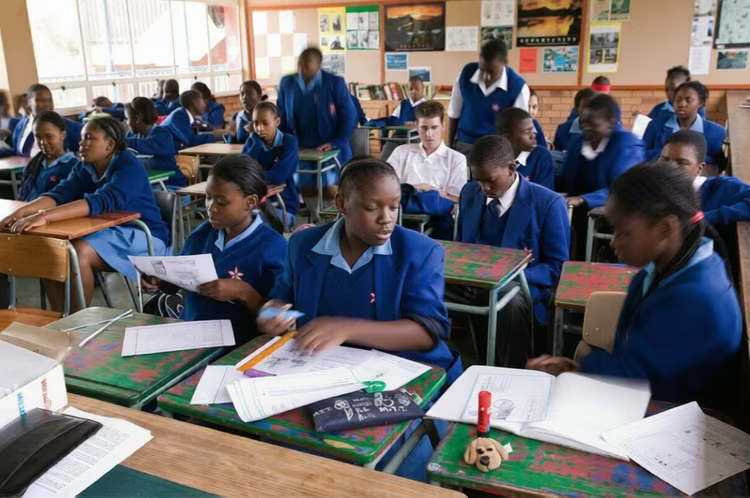
Primary education spanned Grades 1 to 7, guided by the familiar Gateway books. Then, one progressed to secondary school from Grade 8 to Grade 12, with success measured mainly by national examinations. Subjects like integrated science and social studies gave broad exposure rather than early specialisation. The system valued consistency and access, and, for a long time, it worked. It provided a broad, general foundation.
What Has Changed in Zambia’s New Curriculum?
The new curriculum framework was approved in 2023 and began rolling out at the start of this academic year. It restructures the system that many Zambians grew up with. Primary school now ends at Grade 6 instead of Grade 7, and secondary education shifts into Forms, culminating in the reintroduction of A Levels as preparation for university. At tertiary level, some programmes have been shortened, with several degrees structured to run for three years. The aim is to guide learners towards specialised pathways earlier and expand opportunities in STEM and the creative arts. The idea makes sense. Education has changed over the years, and remaining fixed in older models would eventually hold learners back. Still, a plan that reads well must also work for the people inside it, the educators and the students.

Many teachers express cautious optimism. Some say the structure allows them to teach more meaningfully. On the ground, the questions become practical. Is the material available? Was training enough? What support exists after the announcement? Several teachers relied on handwritten notes from draft resources in the opening weeks. Subjects that were one are now individuals. Orientation sessions happened, yet many describe standing in front of learners, still working out the method as they taught it. One phrase keeps appearing in conversations, “We heard the direction but did not practise the journey,” one teacher observed.
Meanwhile, parents, who are essential partners in implementation, sound less angry than uncertain. They are not protesting, but quietly circling the same concerns in different ways as they navigate unfamiliar territory.
- If my child stops at Form 4, is that success or failure?
- If they choose a pathway early, is the door closed later? Can they change their mind?
The reform introduces multiple exits, but society still recognises one finish line. Many parents welcome the return of A levels because they understand them. They also appreciate separating sciences and the push toward practical ability rather than endurance alone.
How Students Are Experiencing the Shift
Students experience the shift just as deeply. Past papers have long guided revision habits, and now learners must rely more on understanding than memorisation. Some appreciate focusing earlier on subjects linked to their interests. Others worry about choosing combinations that keep options open. Group chats now carry different conversations, not just test tips but career questions. One learner online questioned why they should study anatomy if their ambition lies in technology. Another asked which subjects allow switching paths later. The curriculum asks for reasoning and explanation, and for some, that feels empowering, while for others, it feels risky.

Is Zambia Ready for the Reform?
The national discussion is less about reform versus resistance and more about sequencing. Should structure come first and capacity follow, or should capacity lead the change? Authorities have promised that resources will roll out across the country. Many systems eventually stabilise this way. The difficult period sits in the middle where intentions are modern, but routines still belong to yesterday.
The curriculum points somewhere sensible. Perhaps these are simply the growing pains of any reform in its early stages. Teachers translate policy into lessons, parents learn the map through homework, and students make earlier decisions about their futures. Education rarely shifts in one motion. Expectation moves first, and preparation follows behind it. The real question is not whether the reform will work, but whether support will arrive quickly enough and whether all involved are willing to adapt.