Zambia’s roads are finally starting to change, and in places like Kaoma and Kasempa, people are already feeling the difference as they anticipate the completion of a vital lifeline.
It was the middle of December, the height of Zambia’s infamous summer. We held on to the backs of the seats in front of us as the bus rattled, dipped and knocked into craters in the road, deep and wide enough to wash your feet in. Each knock felt like a punch as the sun baked the interior of the small, cramped minibus while dust and hot, humid air swept in through the open windows, baptising us in a thin white film that clung to our skin, mingled with sweat. We were on the road between Sesheke and Livingstone, our annual self-inflicted torture; although it is only about 198 kilometres (usually a two- to three-hour journey), it took five hours and felt like six days. The only bright side was that on the other side, our destination, Namibia, promised straighter, smoother and nearly pothole-free roads.
The story of the Livingstone–Sesheke road is not unique. It could almost be used as a collective reference for the majority of Zambian roads. Ask anyone travelling by road in any season, and they will probably have this to say about Zambian roads:
- The road is bad.
- You cannot go there with a small car.
- Do not attempt it during the rainy season–even big cars get stuck.
And in Lusaka, it is compounded by “heavy traffic”, “it is bumper to bumper”, and a personal favourite, the motorcades.
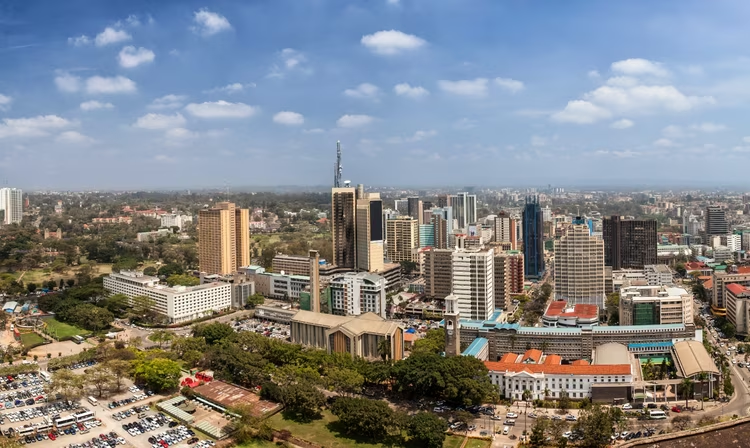
This cautionary tale can be shared with a few of southern Africa’s post-independence countries. Take Nairobi, Kenya’s capital, a city of approximately 4.8 million people and 5.7 million in the metropolitan area. Like Lusaka, Nairobi endured decades of inefficient gridlock due to heavy traffic. Today, the city’s traffic runs almost as smoothly as oil thanks to the Nairobi Expressway, a project delivered through a public–private partnership (PPP).
Across Zambia, several new PPP projects have already begun taking shape, some backed by private partners such as First Quantum Minerals, signalling a shift in how the country intends to rebuild essential infrastructure.
You might be thinking, there is that word again, PPP, the one that keeps getting thrown around to make it seem like something is happening. I met with a friend who returned from North-Western Province after attending the Likumbi lya Mize ceremony and travelling around the Copperbelt. Naturally, the conversation turned to the weather, our hopes for a better rainy season, and how the roads are this time of year. Expecting the usual complaints, he shared something surprising: a section of the road, specifically between Kaoma and Kasempa, was being transformed since the last time we travelled that way. The drive, which usually took six to eight hours, would take him only four once parts of the road are tarred and others graded. As he recounted his experience to me, I recalled my trips between Sesheke and Livingstone: the road there was neglected and lonely, and it had an adverse economic effect on the communities along the route. A new highway like the one he described would mean a lifeline of commerce for vendors and traders along the route.
As the conversation carried on, my friend described an interaction with a shopkeeper in Kasempa. Very little business passes through Kasempa, but he sees the sight of yellow machinery and preparations for construction as a sign of more traffic in the future, which means more business. Even his bus driver friends are anticipating making more trips in a day because breakdowns will become less frequent. Zambians are already friendly, but he concluded they were extra friendly because a new road meant better livelihoods all around.
The Corridor That Could Change the Map
One such road is the Mutanda-Kasempa-Kaoma corridor, a 371 km stretch developed under a 25-year PPP concession (2 years construction, 23 years maintenance) signed by the Zambian government in partnership with Western Corridor Ltd. First Quantum Minerals Zambia (FQM) is a minority investor in this partnership, and its long-term presence in the region provides a level of stability and credibility that large infrastructure projects often struggle to secure.
This project will include three toll plazas, two new bridges (Lalafuta and Luena), and 20 km of urban roads (10 km each in Kasempa and Kaoma districts).

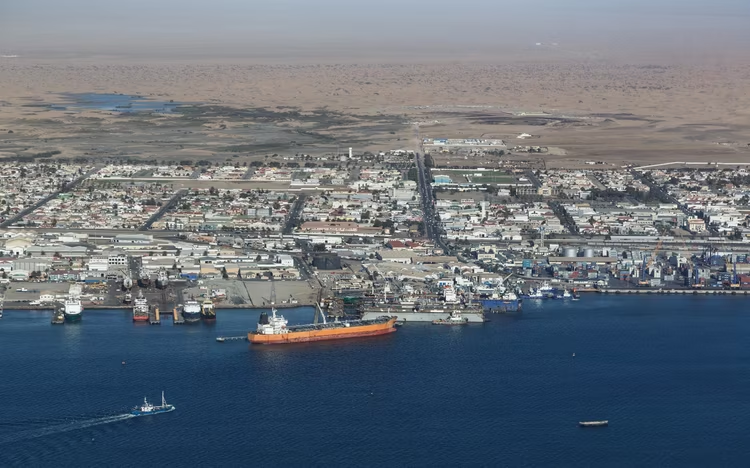
The details matter, but the impact matters more. The road’s construction will change how people and goods move. Rural communities will gain safer, faster access to hospitals and schools, while traders and vendors may be able to access goods and commerce more easily and conveniently, directly impacting their livelihoods. The corridor also links north-western Zambia to the Port of Walvis Bay in Namibia, strengthening its established land-linked ties and creating a more inclusive economy, something that communities in remote areas rarely experience.
This kind of impact from something as ‘simple’ as a tarred road should not come as a surprise. For nearly 30 years, First Quantum Minerals has taken a long-term approach to its operations in Zambia. Their involvement in this corridor fits within that broader view of national development. It is not a slapdash project for the sake of optics; it is part of a strategy to build infrastructure that outlasts political cycles and serves more than the mining sector. FQM’s participation is an example of what a responsible partnership can be. It also demonstrates how private investment can align with national development objectives rather than run parallel to them: the essence of what PPPs are meant to achieve.
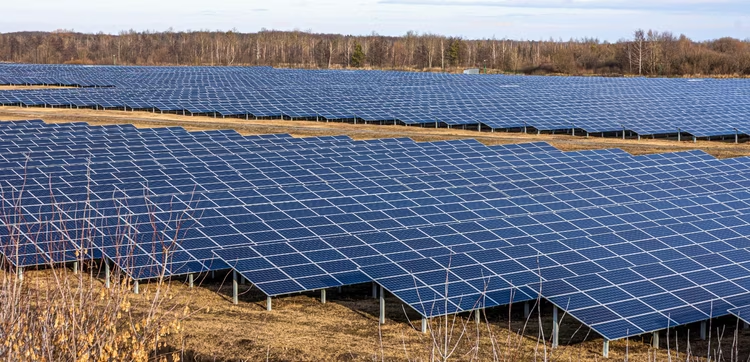
Of course, roads are only one part of Zambia’s story. Energy is the other backbone of progress. Earlier in 2025, GreenCo Power Services, in collaboration with FQM and ZESCO, supported the Chisamba Solar Power Project, a 100 MW development expected to supply up to 50,000 homes, reinforcing the point that infrastructure benefiting everyday Zambians can be delivered through effective public–private partnerships.
Across the region, the fruits of these types of partnerships are evident. Similar collaborations have reshaped entire economies. Mozambique’s Maputo–Katembe Bridge, Namibia’s Walvis Bay Port expansion and South Africa’s renewable-energy programme show how partnerships can deliver the kind of infrastructure that governments alone struggle to fund. These case studies show that Zambia’s push for PPPs is not an experiment; it is following an established pattern that has worked elsewhere when the right partnerships are in place.
Partnerships Are Not Perfect, but They Work
Partnerships do not solve everything. They take time to structure and require transparency, stable agreements and partners who stay committed even when timelines shift. They are slow, sometimes frustrating and often politically sensitive, but that difficulty is built into the model. When done right, they deliver infrastructure that benefits everyone, not just citizens, but the greater SADC region as well.
Zambia is seeing the early signs of that shift. It may be slow and uneven, and it may test our patience, but in places like Kaoma, Kasempa and Mutanda, the change is already visible. Roads that once drained energy and opportunity are gradually opening up routes that connect people, businesses and entire districts.
The next time you travel between Ndola and Lusaka on the dual carriageway, or take the newly improved sections between Kaoma and Mutanda, or even endure the familiar bumps between Sesheke and Livingstone, remember this: progress is happening, not in grand announcements, but in kilometres of road that quietly shorten journeys and open doors. Partnerships are playing a central role in that shift, and if they continue with honesty and persistence, Zambia’s roads may one day tell a very different story.