When major news breaks in Zambia, the real story unfolds on Twitter. Official statements get dissected, conspiracies multiply faster than retweets, and somehow, even constitutional amendments become meme material.
When a major event occurs in the country, I read the news... on Twitter (now X, though everyone still calls it Twitter). People discuss it with a few facts and numerous theories about why it happened. Like reality TV, it's entertaining.
Let's examine some of these events that shook social media.
Zambia's Cybersecurity Law
What happened?
The nation introduced a new Cybersecurity Law, creating an agency under the President's office to handle all cybersecurity matters in Zambia.
Large institutions must register their computer systems and information with the agency, maintain their data within Zambia (unless granted special permission), and conduct regular security checks.
Think of it as a digital police force for computer and internet security in the country.
A few examples:
- Installing spyware on your ex's phone is now a crime.
- If someone hacks your Facebook account, the hacker can be prosecuted under this law.
- If you're suspected of a crime, police can obtain a court order to investigate and monitor your online presence.
Why did it go viral?
The spying part of the conversation is what went viral. People worried that the authorities would be monitoring them 24/7. Much of the frustration came from people thinking the authorities would be monitoring their browsing history.
Like always, Twitter conspiracies started:
- "This is so certain parties can keep an eye on certain tribes."
- "Leadership wants to keep an eye on the opposition."
- "This is so that social media can be shut down during elections."
Even though there was genuine fear about privacy and freedom of speech, Zambians brought their usual humour, joking that even incognito mode would be monitored.
Still, some supported the cyber laws, seeing them as a step towards tighter security. As a writer who researches how killers dispose of bodies, I'll admit the surveillance part worried me too.
Bill 7 Explained
What is it?
Many people didn't even know what Bill 7 was when it started trending. Someone tweeted asking if they were adding a K7 note to the currency, and others joked about becoming lawyers that same day to try to understand it.
Bill 7 proposed a significant shift in how elections work in Zambia. It will expand constituency-based seats from 156 to 211 and introduce proportional representation alongside the current first-past-the-post system. Additionally, instead of holding by-elections when seats become vacant, parties will appoint replacement MPs. This means parties could handpick replacements rather than letting voters decide.
Why did it go viral?
Many cried foul over the lack of public consultation before the bill was introduced. Twitter exploded with accusations of it being undemocratic.
Twitter theories that came about:
- "The elections are being rigged."
- "One tweet summed up the mood: 'Removing mayor term limits? Every African country has that one old man clinging to power forever.'"
- "This is just to increase salaries for the party members."
- "They want to make the system confusing."
Some refused to engage, 'I don't have time for politics' was the common response. Some of us (myself included) tried to understand what it meant, while others worked to raise awareness about how the bill would actually work.
Loadshedding Conspiracies
What happened?
Zambia has been facing loadshedding problems, from having only 7 hours of electricity per day down to just 3. The main reason: Kariba Dam, Zambia's primary electricity source, had critically low water levels.
Why did it go viral?
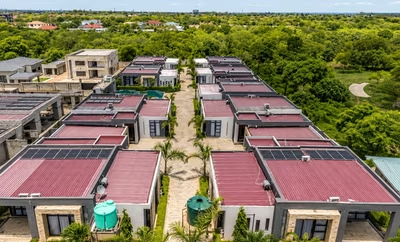
No power. Businesses suffered from heavy loadshedding, and people complained. Citizens have been encouraged to adopt solar energy, and if you look at any neighbourhood roof, you'll notice solar panels everywhere—even during the rainy season when they're less effective.
Twitter theories that came about:
- "Power will return when elections begin. They want us to be happy to vote with joy."
- "They are selling power to our neighbours without thinking of us first."
Loadshedding brought widespread frustration as everyone struggled to adapt. Including me, frantically leaving my phone to charge whenever power returned, hoping a surge wouldn't fry it.
Why Zambians Turn National Crises Into Twitter Trends
Like with every crisis, Zambians find humour in the chaos—it's how we cope. Whether it's cybersecurity surveillance, constitutional amendments, or sitting in the dark for 21 hours a day, Twitter becomes our collective therapy session, town hall, and comedy club all at once.
We dissect policies with the same energy we bring to football debates. We turn our frustrations into memes. We create conspiracies that are somehow both ridiculous and oddly plausible. And through it all, we find ways to laugh—because sometimes, that's the only power we have.
And I find that joy on Twitter or X—my ex, my comfort, my problematic favourite.