Zambia has spent years telling girls to dream big, invest in education, and reach for the stars. Zambia has raised a generation of educated, independent women. The only question is whether the rest of society is ready to catch up.
In Zambia, the path laid out for women used to follow a predictable pattern. Education was pivotal, within limits. You could study, learn a trade, or even earn a degree, but the narrative often ended at home. Women were praised for keeping houses, raising children, and holding families together. It made social sense at the time, but it asked that ambition be shaped around domestic life rather than run alongside it. And it's evident in how, in the 70s and 80s, many women mostly acquired skills in tailoring or other work that accommodated shorter work hours or even working from home. The role of a woman was to pave the way for a successful and healthy life for her husband and children.
That narrative has changed. Girls now have more visible pathways to higher education and careers. Female enrolment in universities continues to grow, with women now representing approximately 35-40% of tertiary education students according to recent education statistics from the Ministry of General Education, compared to less than 20% in the 1990s. And STEM programmes for girls are no longer rare initiatives but common national campaigns. Zambia is witnessing a generation of women whose qualifications and incomes sometimes exceed those of their partners. The change is structural, and society is gradually adapting to it culturally.
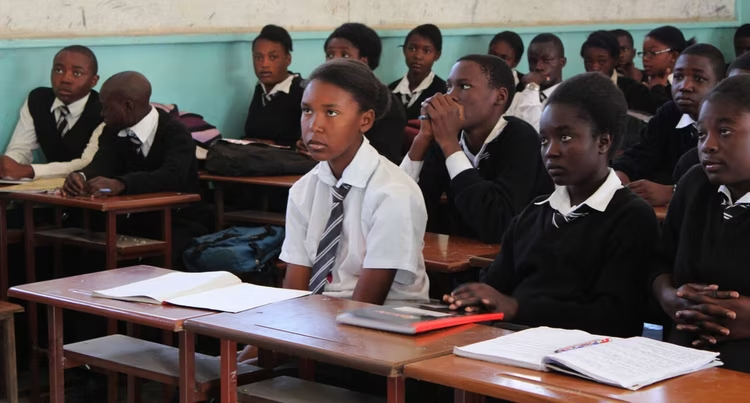
I think about this shift often because I come from a family of only daughters. Growing up, I witnessed how this reality was sometimes viewed through a lens of concern by some relatives and neighbours, questions about whether my parents might have wanted a son, as if daughters couldn't carry forward a family's legacy. Yet today, my sisters and I hold degrees and professional positions, with one of us practising medicine and proudly carrying our family name forward. This evolution in just one generation reflects a broader shift happening across Zambian families, a recognition that daughters are building legacies in ways that might not have been imagined decades ago.
The Rise of Women's Education and Careers in Zambia
While the public's embrace of women's advancement continues to grow, it remains uneven. Many Zambians openly support gender equality in employment and leadership, though educated women who take on visible roles can still encounter mixed reactions. Take, for example, the 2015 appointment of Justice Irene Chirwa Mambilima as Zambia's first female Chief Justice; while widely celebrated, her appointment also prompted conversations about women in positions of authority that reflected ongoing societal adjustments. Similarly, women entrepreneurs often report facing more scrutiny about their business decisions than their male counterparts, or being asked how they balance work and family in ways men rarely experience. Equality reads well on paper, but in daily life, implementation is an ongoing process.
Some professional women speak about navigating personal relationships once they are well-established. Career success can introduce dynamics in personal relationships, particularly when traditional expectations around gender roles remain strong. Professional women sometimes find that their achievements are viewed differently from similar accomplishments by men. What might be seen as ambition and leadership in a male professional can be interpreted differently when displayed by a woman. The challenge lies in the fact that qualities like confidence, independence, and drive universally valuable in the workplace, are sometimes viewed through different lenses depending on who displays them.

In the workplace, progress continues alongside areas for improvement. Zambia's labour laws include provisions for nursing breaks, yet few workplaces offer actual facilities to make this feasible. Many offices have no nursing rooms, no flexible schedules, and no quiet spaces that allow mothers to manage both roles. The gap between policy and practice remains one of the practical barriers that working mothers navigate daily.
Navigating Professional and Personal Life as a Zambian Woman
Social media reveals another layer of perception. When a woman posts about earning a degree or launching a business, the response is almost predictable. Some celebrate her success. Others question her priorities. A few call her selfish or predict that she'll end up alone. It's as if the rise of successful women has unsettled a social rhythm we haven't yet learned to dance to. Pride and discomfort coexist in the same comment section.
Encouragingly, society is gradually learning to embrace ambitious, accomplished women in their full complexity as professionals who are also warm, as leaders who maintain their authenticity, and as achievers who don't fit outdated stereotypes. The shift is happening, though slowly. We're beginning to see more nuanced portrayals that recognise successful women as multifaceted individuals rather than one-dimensional characters. Young girls now have more diverse role models who demonstrate that ambition and femininity, strength and warmth, success and authenticity can all coexist. While media representation and social narratives still have distance to cover, the evolution is underway.
Importantly, not all reactions are hesitant. Many families and communities proudly support their daughters' education, understanding that empowered women strengthen households and economies alike. The opportunity now is to align structures and attitudes more consistently with this support. Society encourages the girl child to dream big, but the structures and attitudes surrounding her don't always follow through. She may be told to reach high, yet reminded later to "stay humble" in ways that subtly keep her small.

Building a Supportive Future for Women in Zambia
That tension is what makes this moment so important. Zambia has invested in empowering its women, but empowerment doesn't end with access to education. It must continue in workplaces, in households, and in the tone of national conversation. When we normalise breastfeeding rooms, equal promotion opportunities, and respectful partnership dynamics, we stop treating educated women as exceptions and start treating them as full participants.
Zambia has changed. It is changing. And it can take this progress an extra mile by embracing practical, consistent steps forward. There are practical changes within reach: firms can create simple family-friendly policies, communities can rethink gendered expectations, and men can reimagine partnership as shared growth instead of control. Change doesn't have to be grand to be transformative; it just has to be consistent.
Zambia has already made significant strides—increased female university enrollment, more women in professional roles, and growing representation in leadership positions. The foundation is strong. Now comes the next phase: expanding these gains by creating workplaces that truly accommodate working mothers, fostering social attitudes that celebrate rather than question women's ambitions, and building structures that support rather than test women who choose both career and family. The question isn't whether Zambian women are capable or ready—they've already proven that. The opportunity now is for institutions, workplaces, and communities to build on this momentum, creating environments where educated, ambitious women aren't exceptional cases but natural participants in every sphere of national life. Because the truth is, Zambia has already raised a generation of educated, independent women. The path forward involves ensuring our structures and attitudes fully support their continued contributions, making their success a seamless part of Zambia’s story.