In a country where power cuts are the new normal, every Zambian becomes an unwilling athlete in the ultimate test of endurance: the Great Load-Shedding Olympics. From the desperate midnight ironing and brutal device Charging Decathlon to the suspicious contents of a powerless fridge.
I’m in a toxic relationship with ZESCO. At first, we were good. Actually, you could even say great. The usual honeymoon phase of any relationship; it feels like the lights turn on just for you whenever you walk into the room. I’d bask in an inner glow—reflecting the one he gave me simply by existing. Communication? He was great at it. If I ever couldn’t reach him, he explained why in advance, even sending a photo of his work schedule, so I’d know exactly when to expect his call.
Now I wait by my meter like a teenage girl waiting for her phone to buzz, thinking that if I phrase things just right, I might get his attention—or even get him back. Every day has become a creative writing exercise: How can I express my torment in the app’s limited characters in a way that’s piercing yet not desperate? How do I emotionally manipulate someone while being gaslit myself? I smile when he shows up for five hours instead of three, because I’ve become accustomed to the bare minimum.
Zambia's Guide to Power Cut Life
On Christmas Day, he came over and stayed until midnight, and I should have been happy. It was the longest I’d seen him in ages, yet I couldn’t shake the edge of suspicion—why would he stay in so long unless he was planning to stay out for longer?
It’s a special kind of mental acrobatics: a hula hoop through fleeting glimmers of good behaviour. A tightrope walk above a dark, relentless cavern that was supposed to be temporary. Like any mental affliction, it spills into the physical. Every Zambian who isn’t committed to a solar panel becomes an unwilling athlete. We sprint at record-breaking speed to the nearest cable at the slightest spark of a bulb. The days of spinning a football being the country's obsession are over. For better or worse, we are all participants in the loadshedding Olympics. We raise our emerald flag high—even if we weren’t able to iron it first.
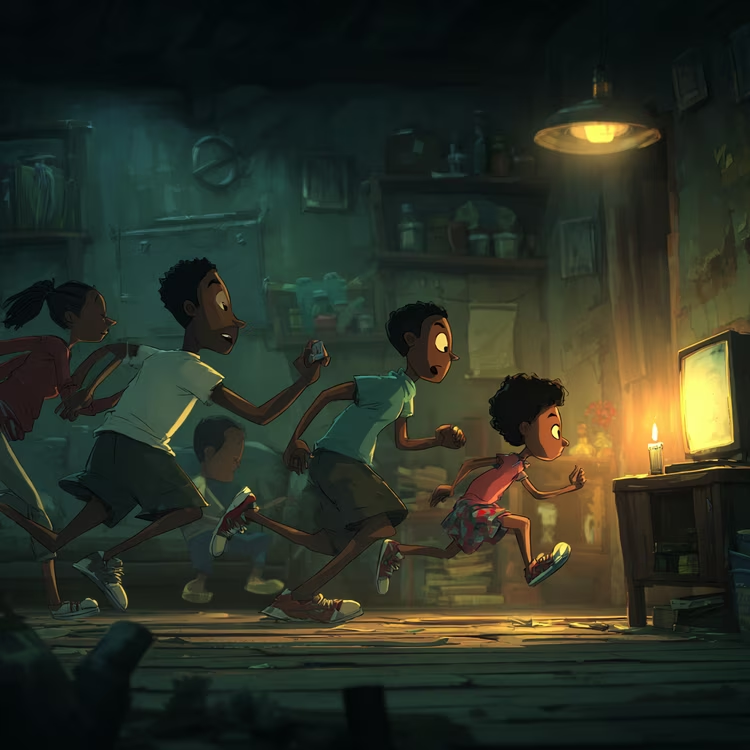
Which brings us to our first event: the War of the Wardrobe. Welcome to an era where, if it looks like you got dressed in the dark, it’s because you probably did—and where access to a functioning iron is a privilege, not a right. The kind of privilege that, if exercised, has you stretching out the metal legs of an ironing board at 2 a.m., a week’s worth of intended outfits pooled at your feet, and a single prayer on your mind: that you’ll smooth out the final wrinkle before the light disappears like an ancient comet with far more important places to be (allegedly Botswana).
The War of the Wardrobe forces you to rummage through the mental archives for fragments of primary school science that might somehow allow you to straighten a dress. I have seen smoke strategically blown toward T-shirts and skirts suspended over steaming bathwater. I have seen doctors and nurses in uniforms so crinkled you’d think a new and innovative virus had arrived—one that only affects clothing. And I have seen all of us slowly disinvest in caring. Gone are the days when you’d be judged for clothes that weren’t crisp or starched. On the long, candle-lit march to the finish line of this marathon, we all have far bigger concerns.
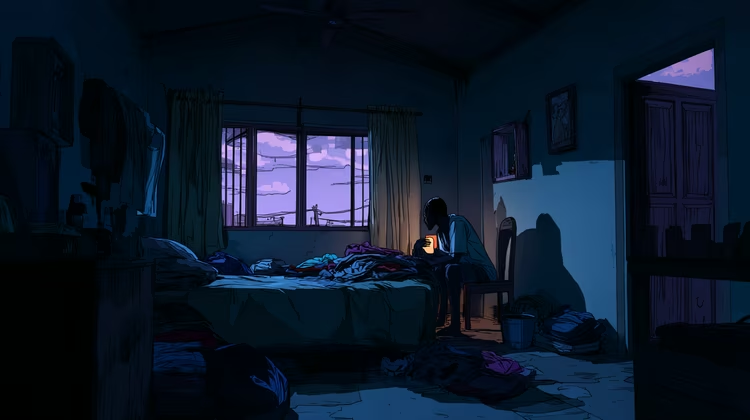
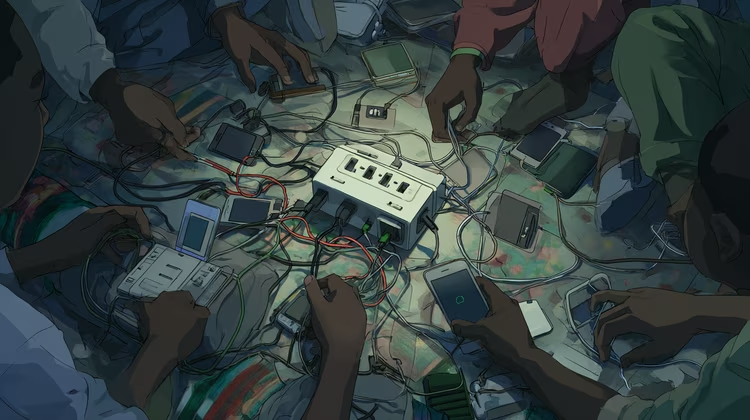
The digital age has brought us a level of ease that can’t be underestimated. But with the convenience of running our lives at the click of a button comes the burden of moments when we don’t even have enough electricity to turn that button on. The devices that hold our work, family, and social lives hostage only have as much power as the sockets we plug their chargers into. And these days, you need several: phones, tablets, laptops, Kindles—all competing for a three-hour window of possible charge, while you try not to create such a tangled web of cables in desperation that you blow the circuit completely.
How to Prioritise Devices During Load Shedding
Welcome to the Charging Decathlon. Like a mother in the middle of a drought, faced with too many cubs and too little nourishment, you are forced to choose. Phone or laptop. Tablet or speaker. One gets fed; the others are left to succumb to their elements. It’s a brutal test of endurance, strategy, and emotional detachment because in the Load-Shedding Olympics, sentimentality drains power faster than anything else.
Is Your Food Safe?
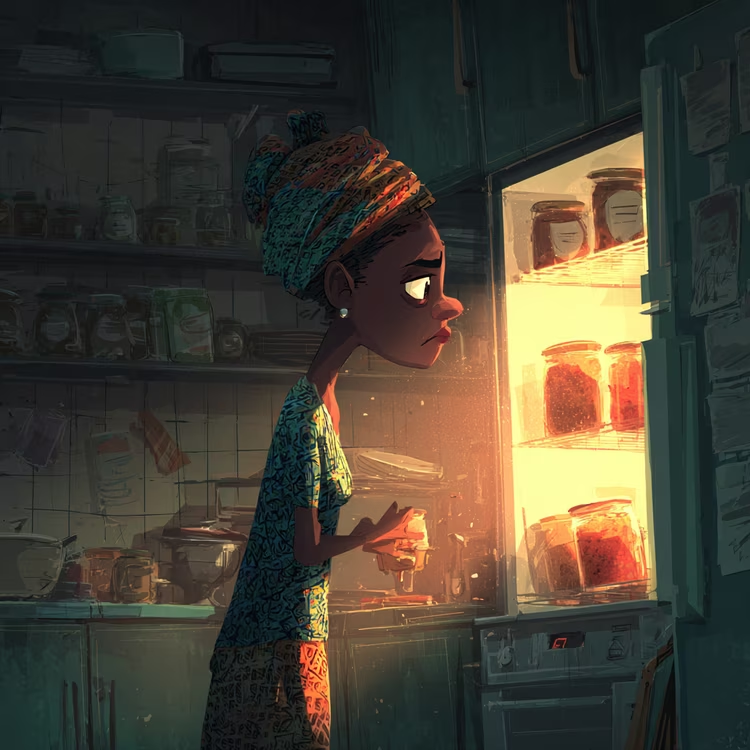
As if it weren’t enough that our cellphones were malnourished, what about us? The icebox—the fridge—an invention that once freed our ancestors from countless illnesses and gifted them time through the miracle of food preservation, now sits in our kitchens like an overqualified cupboard. It offers the occasional gust of cold air and a warning beep if the door is left open, but little else.
What happened to milk? Real milk—the full-cream kind, not the long-life variety that tastes as if it has already made peace with its mortality. What happened to the giant tubs of ice cream that used to see us through summer, waiting faithfully in the freezer like a promise? All of it is lost to landing on the red of the Refrigeration Relay.
Every grocery trip is a gamble. Hauls are smaller, visits are more frequent, and anything left in the fridge longer than a day is regarded with deep suspicion. Lids are lifted slowly, noses lean in cautiously, and every container carries the thrilling possibility of either dinner or an unscheduled attempt to test the efficiency of NHIMA. So we adapt. We live as our ancestors once did—hunting and gathering daily, favouring dried, preserved, and powdered foods with real staying power and fewer biological ambitions. Meat goes straight from market to fire, no warm beeping cupboard, or the company that powers it, is trusted with a resource so precious.
In the end, the Load-Shedding Olympics has no closing ceremony, no medals, and no clear winner. There is only endurance, improvisation, and the quiet pride of making it through another day with your phone at 17%, your clothes slightly wrinkled, and dinner eaten the moment it was cooked. I like to think that one day we’ll talk about these days of darkness the same way some of our elders talk about their compulsory time in National Service. Misty-eyed, describing it as torture, yet somehow sounding heroic—almost fictional—to a group of youngsters gathered around a fire, privileged enough, we hope, to never have to experience it for themselves.