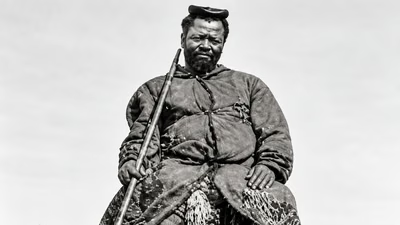
One of the most pivotal and paradoxical figures in Zambian history. Rising to power in the unstable, post-Makololo Bulozi of the late 19th century, Lewanika survived exile and internal rebellion to ruthlessly centralise authority, earning his name "The Conqueror."
The Bulozi region was known as a land of blood, where kings and chiefs succeeded one another in quick succession, rarely living to an old age. However, King Lewanika, recognised for his innovation and strategic acumen, was an exception; he survived into old age and maintained his rule.
Origins
However, before he became King Lewanika, he was known as Lubosi/Robosi. The land of Bulozi before his time faced one crisis after another, from a succession crisis that followed the death of Mulambwa, the 10th ruler of Bulozi in the early 19th century, to internal political instability and the invasion and conquest of Bulozi by the Makololo.
In 1864, the Makololo were overthrown, but internal stability was not restored. Lubosi’s uncle, Sipopa, was the principal chief of the tribe from 1864, having re-established the territories belonging to the Lozi. But his cruelty towards his people led to an uprising in 1876 that saw Sipopa murdered by his own people.
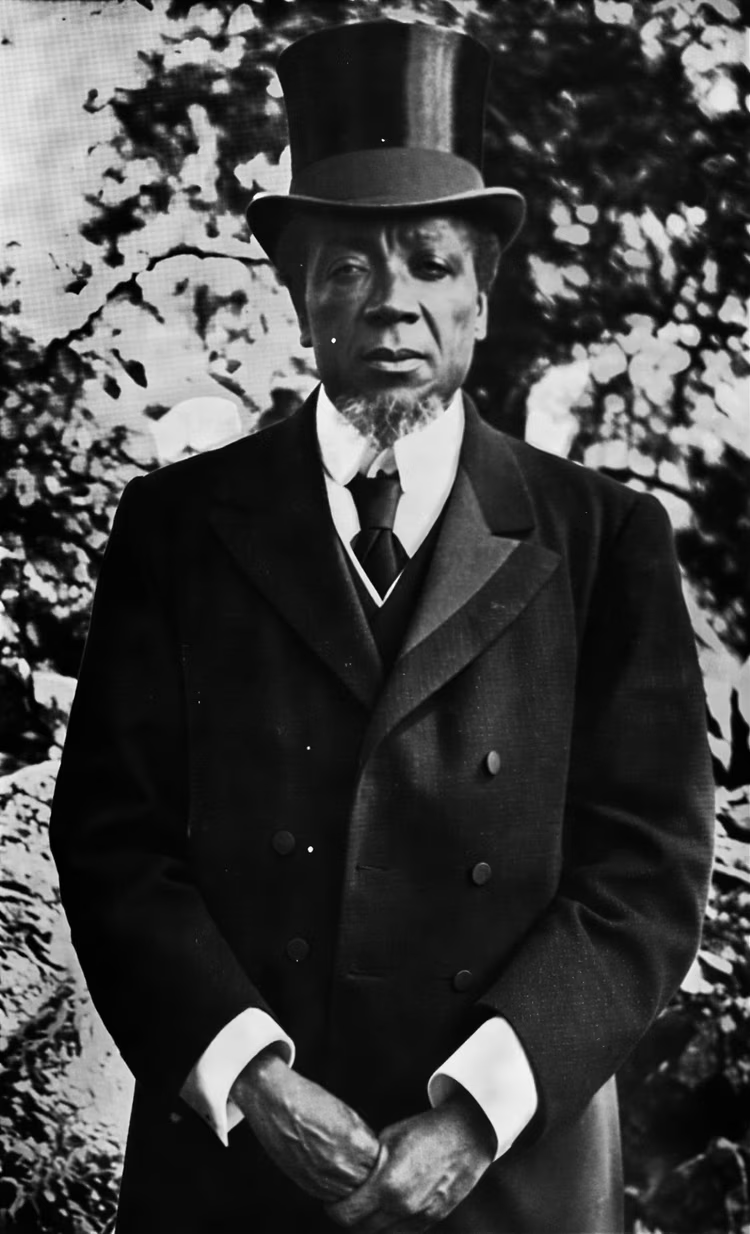
Throne and Exile 1878
After Sipopa, Succession allowed Mwanawina to sit on the throne, and he did for 2 years until the favour of the people rested on Lubosi, who replaced him as king. Lubosi succeeded Mwanawina in I878.
But the Banosha family, who had led the revolt against Sipopa, fired several shots into Lubosi’s hut in his capital, Li-a-Liue, forcing the king to run for his life. He was replaced by puppet king Tayela/Tatila (Sipopa’s nephew) in 1884.
In January 1885, missionary Coillard arrived and was greeted by those related to Tayela, including Mukwae Maibiba. They told him, “Ours is a land of blood. Kings and chiefs succeed each other here like shadows and are never allowed to grow old.”
Return to Power (Late1885)
Towards the end of 1885, Lubosi led a successful counter-coup. The support for Mukwae and Tatila had waned after less than a year in power, allowing Lubosi to reclaim his throne.
Eliminating Opposition
Once back in Bulozi, Lubosi was determined to prevent a repetition of 1884.
The problems Lubosi had to face were reflected in the history of Bulozi following the Makololo overthrow. Both Sipopa and Mwanawina fell from power as a result of rebellions.
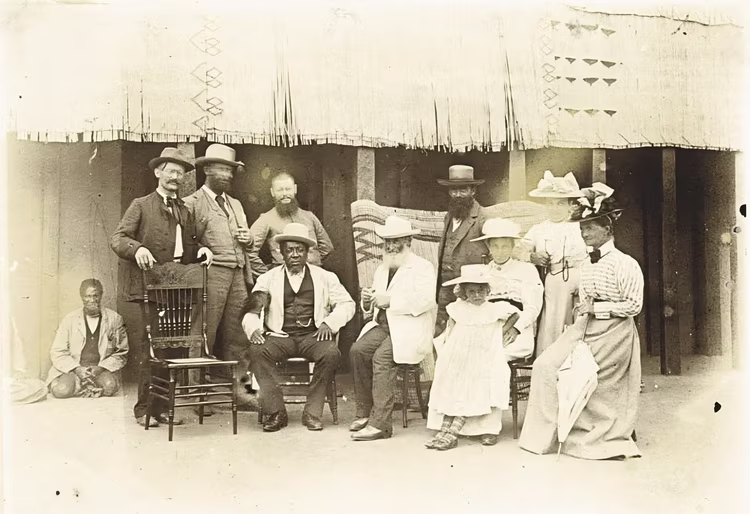
When Lubosi regained power, he changed his name to Lewanika (Conqueror). He was merciless. As George Weslbeech writes in Trade and Travels in Early Barotseland, ‘The King now, I am sorry to say, began to show his capacity in the killing line, for all who were caught or came to surrender themselves, trusting to his former clemency, were immediately killed. Even the women, wives of rebels, were ripped open by the assegai and thus left to die.”
This killing was the reason the missionary Francois Coillard came in 1889 to preach the gospel. It was under Coillard’s influence that the king applied to Queen Victoria via Cecil Rhodes and the British South African Company to make Barotseland a British protectorate in 1890.
Rewarding Loyalists
The Lozi kingdom was made up of a King, the Kuta (the national council), and Indunas (Ministers/governors) who were non-royal but controlled districts and resources.
To strengthen his position, Lewanika elevated to Indunas and positions in the national council those who had fought for him and supported him.
The bureaucracy came to consist mainly of “The king’s men.” He allowed the princesses' husbands to sit on the council, adding a loyal voice and increasing the number of seats on the council for members of the royal family.
To prevent succession rivalry, he changed the succession in the southern administrative region from male to female rulers who were close relatives.
Lewanika wanted every decision to go his way, and he made sure of it.
Military Success
He led successful military campaigns:
- Raiding the Ila and Batoka, capturing about 20,000 head of cattle.
- Advanced against Chief Monze’s area and captured cattle and slaves.
- Intervened in the war between the Lunda of Shinde and the Luvale, bringing “hundreds of women and children as booty.”
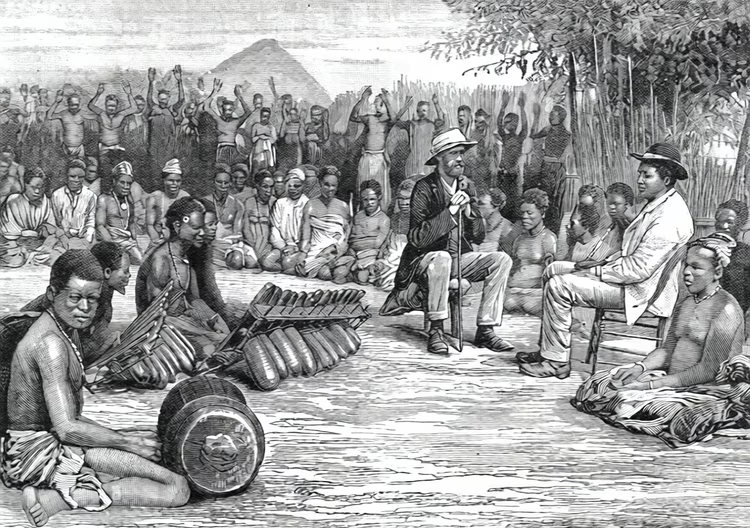
The British South Africa Company
The first treaty with the B.S.A. company was signed in 1890 with Frank Lochner, but it lapsed because the company was unable to meet its commitments for seven years (Up to 1897).
By 1898-1900, Lewanika was in a far stronger position than in 1890. A new agreement was drawn up in 1898, then revised and finally signed in 1900.
The treaties included a condition that Bulozi Proper (Floodplain) should be reserved for the exclusive use of the Lozi. These concessions provided the basis for B.S.A company claims to be in north-western Rhodesia.
Legacy
You can say it is ironic that with his success in gaining full control within Bulozi and having an influence with outside forces, it allowed the British, through his concessions, to win almost the whole of northwestern Rhodesia peacefully and cheaply.
But King Lewanika abolished the slave trade in Barotseland in 1906 and established schools and workshops to encourage practical trades. He allowed missionaries into his land not just for the gospel but also hoped that they could instruct his people to read and write, especially to train themselves as carpenters, cabinetmakers, blacksmiths, and for other trades.
In 1902, King Lewanika set sail for England to visit his sons, who were educated in England, where he was invited to attend the coronation of King Edward VII. He was given an audience with the king and held informal talks with the Prince of Wales (King George V).
Lewanika ruled until he died in 1916. On his deathbed, he left a country with secure borders and the protection of the British Empire.
The king was succeeded by four of his sons.