History rarely remembers the women who built kingdoms, but Lueji wa Nkonde's legacy is impossible to erase. In seventeenth-century Central Africa, she inherited a fractured kingdom, united competing factions, and established governance structures that still shape the DRC, Angola, and Zambia today. She chose a political marriage that brought military strength, but ended it when her husband became a tyrant. She prioritised her people's welfare over personal loyalty.
In the 1600s, when a Lunda king faced rebellion from his ambitious sons, he made a decision that would reshape Central African history: he gave the throne to his youngest daughter. Lueji wa Nkonde inherited a fractured kingdom and transformed it into an empire whose governance structures still shape the DRC, Angola, and Zambia today. She married for political alliance, then divorced when her husband became a tyrant. She chose her people over personal loyalty, stability over tradition, and left a legacy that proves African women wielded recognised political authority long before colonialism erased their stories.
The Queen Who Shaped Central Africa's Political Legacy
Lueji lived in the seventeenth century and was born into the royal household of the Lunda as the youngest among six children, three sons and three daughters of Mwata Iyala Mwaku. Succession within the Lunda polity was not entirely automatic. Authority rested on the ability to maintain unity, protect the people, and preserve the stability of the kingdom. Oral traditions recount that Mwata Iyala Mwaku experienced serious altercations with his sons, whose conduct and ambitions created tension across the kingdom. These disputes affected governance and led him to question whether his sons were capable of taking up the throne.
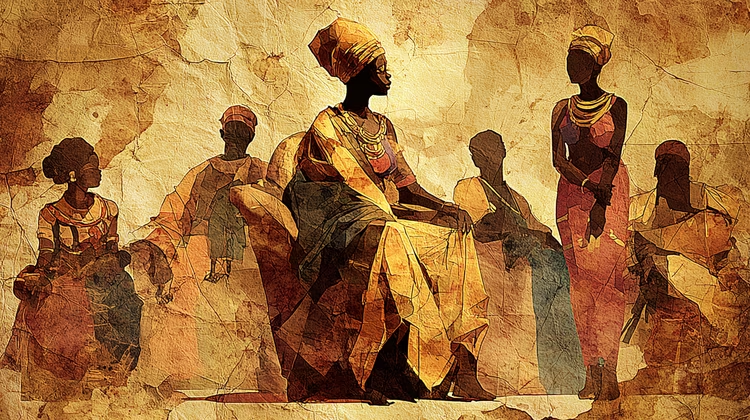
Against this known history, Lueji distinguished herself. She is remembered as attentive to counsel and capable of unifying competing interests. In this context, her father’s decision to appoint her as successor was therefore strategic rather than sentimental. By transferring the Lukano bracelet to Lueji, Mwata Iyala Mwaku publicly affirmed her legitimacy as Nswana Mu Luunda, the sovereign ruler of the Lunda. This decision reflected a clear preference for stability and moral authority over seniority or gender, which was rare at the time.
How Lueji wa Nkonde Became Queen
Once in power, Lueji faced the political expectation placed upon all rulers of the time, except that several members had reservations, as she was a woman. The continuity of the kingdom required an heir, and her royal advisors, therefore, counselled her to marry, not as a personal pursuit but as a responsibility tied directly to statecraft. She needed to protect her position by bearing an heir.
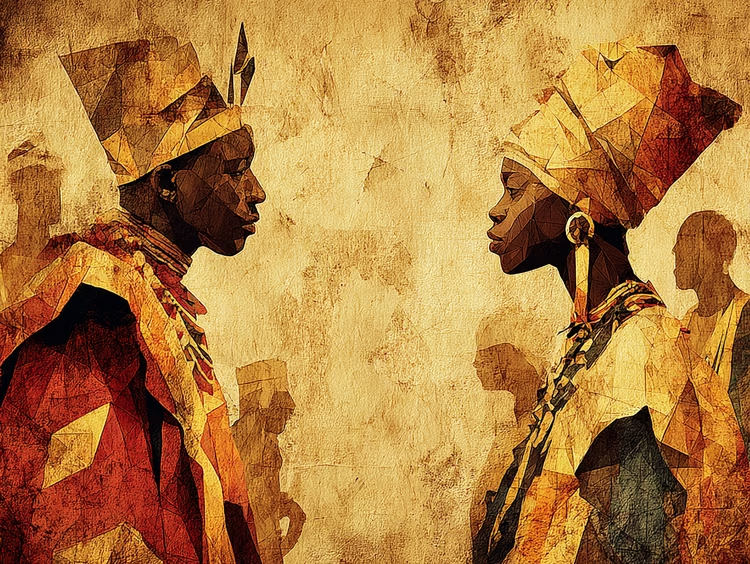
She later married Chibinda Ilunga, a nobleman and hunter from the Luba kingdom, functioning as a political alliance between two powerful societies. Through this relationship, Luba's ideologies of kingship, military practices, and administrative ideas were incorporated into the Lunda system, contributing to the emergence of the Luba-Lunda political sphere that would later extend across vast territories.
The Luba-Lunda Alliance
Oral histories state that this alliance had negative consequences. Chibinda Ilunga is remembered as a tyrant who clashed with Lunda customs and treated subjects harshly. His actions caused fear and resentment, destabilising the order Lueji worked to protect. However, tradition holds that Lueji remained in charge and did not give up authority to her husband. Their marriage ended, and he returned to his homeland. Lueji’s leadership stands out for this: she recognised tyranny and put her people’s welfare above marital loyalty or political gain.
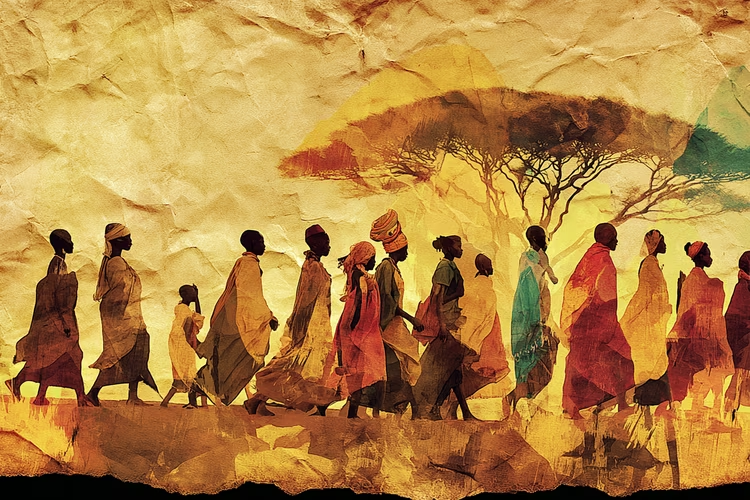
Lueji’s reign set in motion a period of mass expansion. Lunda governance structures spread as groups migrated and established chieftaincies that retained political and cultural ties to the Lunda centre. These movements explain the shared institutions, titles, and traditions still found across Central and Southern Africa today.
How Lueji's Legacy Spread Across Africa
Her legacy extends beyond geography. Lueji wa Nkonde is remembered as a ruler who understood power as custodianship rather than domination. Her story affirms that women held recognised political authority within precolonial African systems and that leadership was judged by conduct and consequence. She remains a foundational figure because her decisions shaped a policy that endured, and because her rule left lessons about governance that communities continue to carry forward.